
Recurring ice does not automatically prove a failed defrost heater. Door sealing, drains, airflow, and model-specific defrost controls must be considered.
When a Sub-Zero seems not to defrost, the ice is often being fed by a moisture source such as a door that does not seal, a clogged drain, or an ice-maker fill problem, rather than by a failed defrost part. Check the door and gasket first, then look at where the frost sits. If ice comes back after a complete defrost and the seal is good, book a diagnosis.
Most Sub-Zero refrigerator and freezer sections use automatic defrost strategies, although the exact system varies by product generation. A refrigerator that appears ‘not to defrost’ may actually have an air leak, blocked drain, or airflow problem creating ice faster than the normal cycle can manage.
The location and recurrence of the ice are more useful than the assumption that a heater has failed.
| Symptom | What it can point to | What you can check |
|---|---|---|
| Frost along the door opening | Humid room air getting past the seal | Look for a torn or folded gasket, and confirm drawers and baskets are seated |
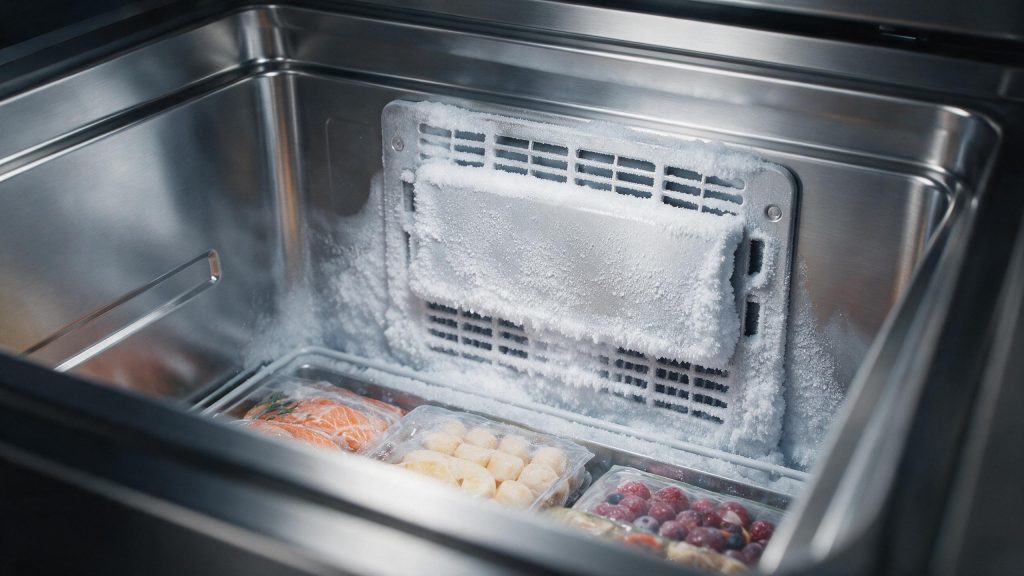
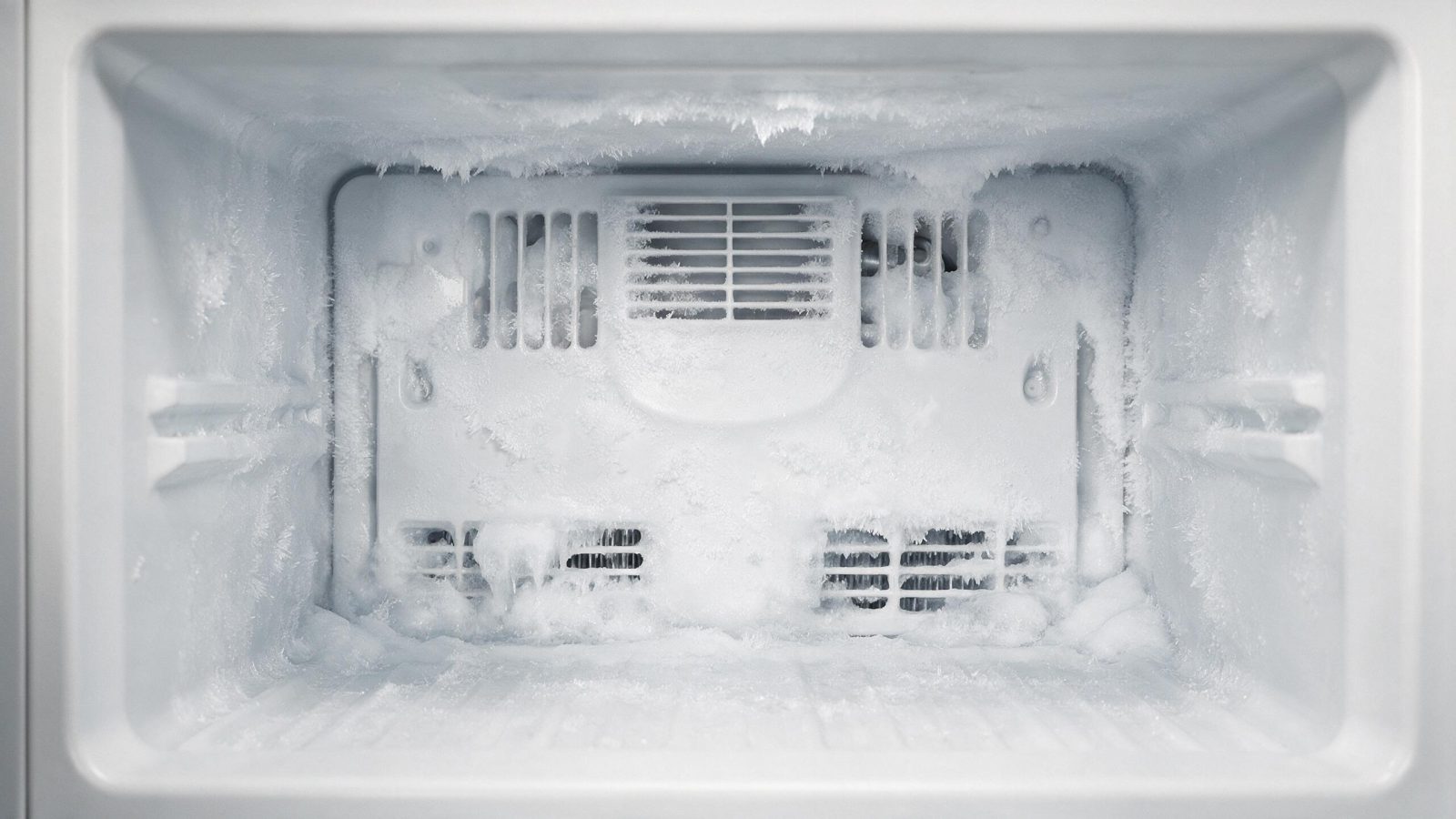
| Ice on the back wall or fan cover | Airflow, drain, or defrost conditions | Take a photo, note the freezer setting, and keep food clear of air passages |
| Water that refreezes under drawers | A frozen or clogged drain | Look for debris or ice where the model allows; do not probe hidden tubing |
| Ice around the ice-maker area | Water entering where it should not | Check whether the fill area looks frozen and whether the ice maker is filling normally |
| Light frost on an ice bin | Normal moisture during a defrost cycle | Empty, rinse, and dry the bin and see whether frost returns |
Frost around a door opening suggests humid air entry. Ice on a back wall or fan cover can be connected with airflow, drain, or defrost conditions. Water that refreezes under drawers may point toward drainage. Sub-Zero lists several causes for freezer frost: a door left ajar, a frozen or clogged drain, a torn gasket, a failed defrost element, and an ice maker that is not filling properly.
Take a photo before defrosting. It gives a technician a much better clue than a clean evaporator after all evidence has melted.
A light fog after the door has been open is normal, and the best response is to keep the door closed. A small amount of frost on an ice bin can also appear during a regular defrost cycle, which is why Sub-Zero guidance suggests emptying, rinsing, and drying the bin from time to time. Thick ice that spreads across a wall, covers a fan area, or keeps coming back is a different situation.
On some Classic and 600 models, basket retainers can also play a role in frost, so the manual for your model is worth a look before assuming a hidden fault.
Each of these checks narrows the search. A good seal and a clear drain shift attention toward airflow and the defrost system, while a poor seal explains frost on its own. Because the cause decides the repair, changing settings or defrosting repeatedly without checking the source tends to hide the pattern rather than solve it.
Follow the procedure for the exact Sub-Zero series. Some products allow a compartment to be disabled independently; others require the entire unit to be turned off. Remove food, protect the floor with towels, and allow ice to melt naturally.
Expect the process to take a while. Guidance for several models describes leaving the door open for several hours while the ice melts, and allowing about 24 hours afterward for temperatures to recover. Some products, including certain Classic, Designer, and PRO models, must be fully turned off rather than having one section disabled, so confirm which applies to yours.
Do not use knives, screwdrivers, high-heat guns, or open flames. The evaporator and refrigerant tubing can be close to the ice.
If ice returns after a complete defrost and the door seal is good, a technician may need to test a heater, sensor, fan, drain condition, control board, or other model-specific component. Electronic-control models and older timer-controlled products do not use the same defrost hardware. Electronic-control models also keep service messages that a technician can read, which is another reason not to clear a message while the problem is still present.
If the freezer stays clear for a while after a manual defrost, the ice was most likely tied to a one-time moisture event such as a door left open. That does not rule out a slow drain or gasket problem, so keep an eye on the same area for a few days. If frost returns in the same spot, that location is the clue a technician will want, and it is the reason a photo taken before defrosting is worth having.
Condenser care matters too, but the right interval depends on the model, so use that model’s care guide rather than a general rule.
Many Sub-Zero refrigerator and freezer sections have automatic defrost, but the strategy varies by series and age.
No. Air leakage, drains, airflow, and ice-maker water issues can all create frost or ice.
Avoid concentrated heat and sharp tools. Use the model-specific manual defrost procedure instead.
Frost on a bin can be part of normal defrost behavior. Emptying, rinsing, and drying the bin occasionally is a routine many models recommend, and heavy frost beyond the bin is worth a closer look.
Plan on roughly a day for the compartment to return to its setpoint. If temperatures are still high after that, or frost returns quickly, schedule a diagnosis instead of defrosting again.
If the symptom continues after the owner-safe checks above, schedule a professional diagnosis. You can also review our Sub-Zero repair services before booking.
Use location and timing to determine whether refrigerator condensation is temporary humidity or evidence of a sealing or drainage issue.
Before replacing a valve or drain part, determine exactly where the water is appearing.
Find the likely source of freezer frost before defrosting or replacing parts.
Share a few details and we’ll confirm an appointment. Prefer to talk? Call us and we’ll help right away.
Fields marked with * are required.