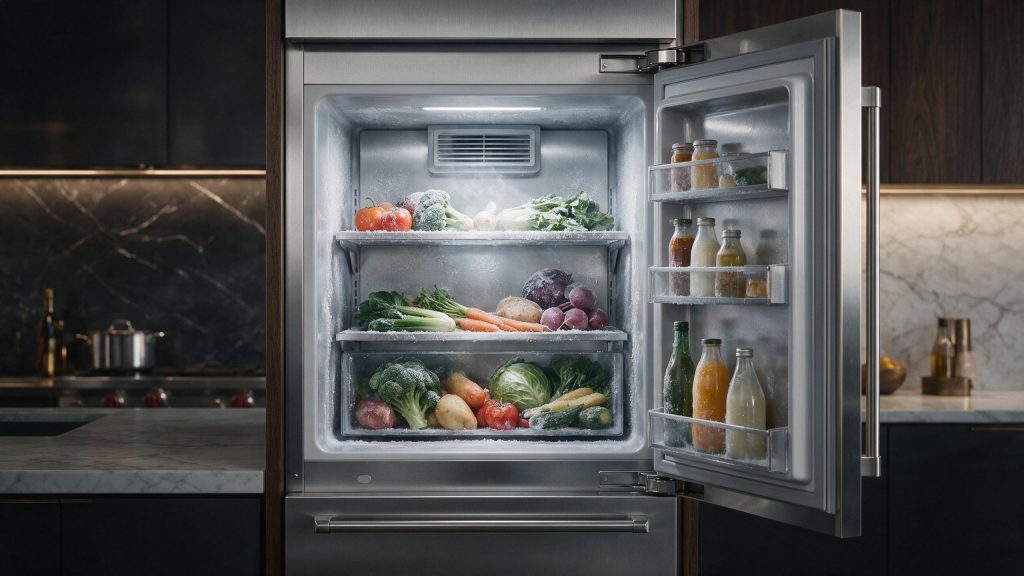

A fan that seems silent with the door open is not automatically failed. Use temperature and airflow symptoms to confirm the problem.
A Sub-Zero fan that looks idle is not always faulty, because many fans are controlled by the appliance and may pause when a door is open. Judge the symptom instead of the blade, meaning uneven temperatures, poor airflow, or noise after the door closes. Clear the air outlets, look for ice near the fan cover, and book a diagnosis if the pattern remains.
Sub-Zero evaporator fans are controlled by the appliance and often change behavior when doors open or close. On some models, a fan switch tells the control when the door is closed. That means a fan can appear inactive during a casual visual check even though it operates normally with the door shut.
Treat the symptom—poor airflow, uneven temperatures, or fan noise—as more important than whether you can see a blade moving.
| Symptom | What it can point to | What you can check |
|---|---|---|
| Fan seems still with the door open | Normal door-controlled fan behavior | Close the door and listen for the fan to start |
| Buzzing or scraping after the door closes | Ice or packaging touching the fan area | Look for ice near the cover and move food clear of outlets |
| Noise stops when all doors are open | Airflow or fan-related noise | Close one compartment at a time to see where it returns |
| Noise continues with every door open | Something other than an evaporator fan | Note where it seems to come from and whether cooling changed |
| Freezer cold, refrigerator warm | Refrigerator-side airflow, fan, or sensing | Check outlets and the door seal, then record the temperatures |
Compare upper and lower compartment temperatures, keep food off air outlets, look for frost near a fan cover, and listen for fan noise after the door closes.
The door-open test is a simple way to separate noises. Sub-Zero guidance suggests opening all doors first, because a sound that continues is unlikely to come from a fan. Then close only the refrigerator door, and afterward only the freezer door, to see which section is responsible.
Some Classic and legacy models have accessible switches, while newer Designer and other series handle these functions differently. Do not tape, jam, or electrically bypass a switch to force a fan on.
A condenser fan pulls outside air through the condenser, and its sound can easily be mistaken for the compressor or for an interior fan. On some older models the condenser fan runs all the time, while on others it cycles with the compressor. Models with air purification have an additional small fan. Knowing which fan you are hearing prevents a lot of wasted checking.
If an accessible switch is obviously stuck or does not actuate normally, that observation is useful for a technician, but replacement should follow model-specific service information.
A fan blade that contacts ice may buzz, scrape, or stop. The underlying cause may be a door-seal, moisture, drain, or defrost issue rather than the motor itself. Removing ice without correcting the source only delays the symptom. Packaging pushed against an air outlet can imitate a fan fault by cutting airflow without any part failing.
If defrosting is necessary, use the correct Sub-Zero procedure for the series and never use sharp tools around the evaporator.
One practical point is timing. If the fan sound begins only a moment after the door closes, that is consistent with a door-controlled fan doing its job. If the sound begins late in the day or after a long period of heavy use, ice forming near the fan is a more likely explanation, and the frost pattern is the better lead than the fan itself.
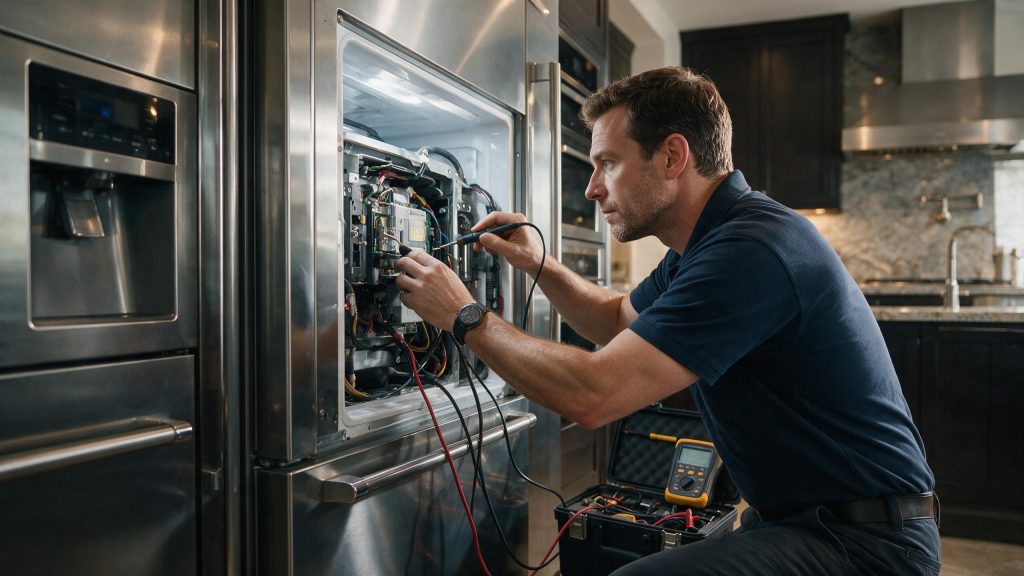
If the unit has poor temperature distribution and the basic airflow and frost checks do not explain it, service may need to test the fan motor, switch, sensor, wiring, or control output. Avoid live-voltage testing unless you are qualified.
Fan layout, switch type, and control behavior differ between Classic, Designer, PRO, and older families. Instructions that apply to one may not apply to another, so the use-and-care manual for your model is the right reference. The condenser area is part of this picture: if the grille is covered or enclosed by custom cabinetry, airflow can suffer, and that is an installation matter for a technician.
Describing the behavior precisely helps. Telling a technician which section is warm, whether the noise changes with the door, and whether ice is visible near the fan cover saves diagnostic time and avoids replacing a part that was never at fault.
Not necessarily. Many refrigeration fans are controlled by door position, so an open door can stop normal fan operation.
Yes. Ice around a fan can obstruct the blade or airflow, but the reason the ice formed also needs to be diagnosed.
A large temperature difference within one compartment, or a cold freezer with a warm refrigerator, can point toward airflow or fan issues.
It can be a sign of an electrical or motor issue. Stop troubleshooting, and contact service.
Sounds are more noticeable in quiet rooms and open-concept homes, and fans can change speed with load. A new or louder pattern together with temperature changes is the point to book.
Yes. On some Classic and Designer models, lighted shelves can buzz if they are not seated against their sensor. Reseating them is a quick check before suspecting a fan.
If the symptom continues after the owner-safe checks above, schedule a professional diagnosis. You can also review our Sub-Zero repair services before booking.
Food freezing in the refrigerator section is usually a control or airflow problem—not a reason to keep raising the setpoint blindly.
Do not condemn a Sub-Zero compressor based on sound or run time alone. Several simpler faults can produce the same symptoms.
Separate normal short-term temperature movement from a refrigerator that truly cannot hold its setpoint.
Share a few details and we’ll confirm an appointment. Prefer to talk? Call us and we’ll help right away.
Fields marked with * are required.